Dehumidifier or Heater? The Smart Way to Keep a Shed Dry
The Piano Tuner's Shed
I once met a piano tuner who kept a workshop at the bottom of his garden - not for tuning, but for restoring old uprights. Inside, rows of keys, soundboards and tuning pins lined the benches. He told me something that stuck: 'You can tell a leak before you can see it - the shed dehumidifier reveals changes long before you see the first drip'
When the roof felt split one winter, his humidity gauge jumped overnight from 55 percent to over 80. The next morning the water tank on his desiccant dehumidifier had filled twice as fast. Before a single drip appeared inside, he already knew the shed had sprung a leak.
That story sums up what most of us miss about moisture: you can't control what you don't measure, and you can't measure what you're only guessing at. A small dehumidifier, used properly, turns guesswork into control.
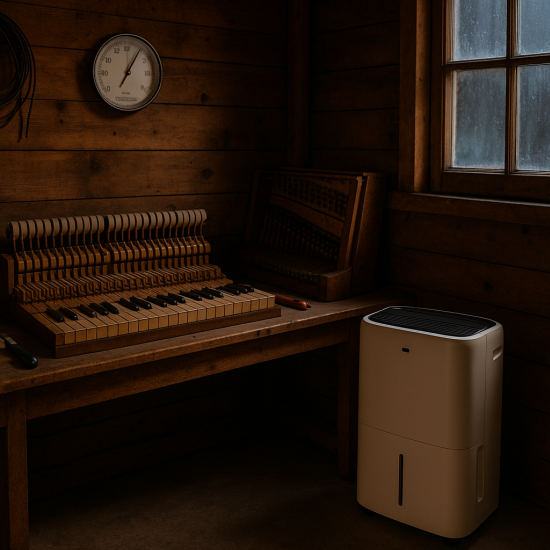 Dehumidifier working to reduce humidity
Why a Shed Feels Damp in the First Place
Even when there's no visible leak, most sheds behave like uninsulated mini-greenhouses. Warm air from daytime seeps in, cools overnight, and can't hold its moisture. The result: condensation on the coldest surfaces - metal tools, window glass, even the undersides of roof sheets.
Timber rarely shows droplets, but it quietly absorbs moisture until it feels clammy. When that moisture can't escape, relative humidity stays high and rust, mould and rot quietly get to work. The goal isn't just warmth; it's balance - keeping the shed's air and materials dry enough that the dew point never catches up.
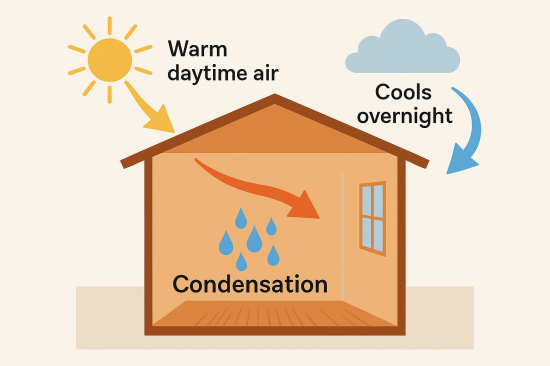 How humidity moves and causes condensation
Why Heating Alone Doesn't Work
Heating a shed feels like the obvious fix. The air warms, relative humidity drops, and the windows clear - job done. Except it isn't.
The total amount of water vapour in the air hasn't changed. Turn the heater off, the temperature falls, and all that vapour reappears as droplets. The moisture was never removed - only hidden.
Worse still, heating a damp shed can drive vapour deeper into timber or insulation, where it condenses out of sight later. That's why the piano tuner didn't just heat his shed; he dried it.
How a Shed Dehumidifier Actually Removes Water
Unlike a heater, a shed dehumidifier extracts water from the air and drains it away. Every litre collected is a litre gone from the shed - not waiting to condense later.
Most modern units use one of two systems:
**Compressor (Refrigerant) Type**
- Works like a mini fridge: air passes over cold coils; moisture condenses and drains away.
- Most efficient at temperatures above 12-15°C.
- Cheaper to run in warm weather but less effective in the cold.
- Ideal for heated sheds, summerhouses, or workshops that stay mild year-round.
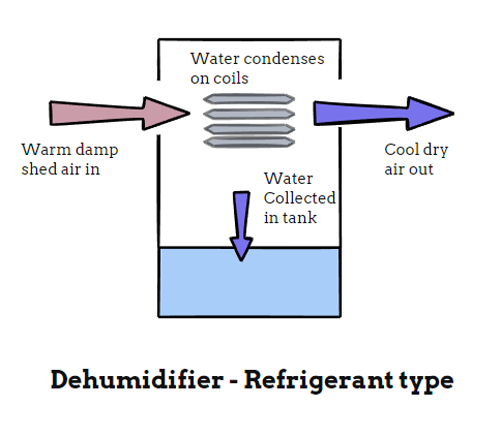 How a Refrigerant Dehumidifier works
**Desiccant Type**
- Draws air through a rotating silica-gel wheel.
- A small internal heater dries part of the wheel continuously, releasing the moisture into a drain.
- Works well even near freezing and gently warms the air by 5-10°C.
- Perfect for unheated timber sheds through autumn and winter.
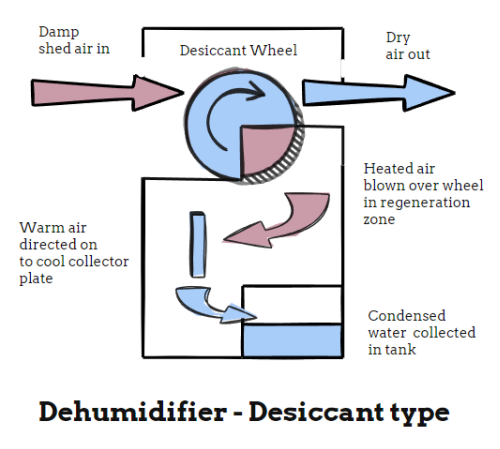 How a Desiccant Dehumidifier works
Some modern hybrids combine both systems, switching automatically with temperature.
Why a Dehumidifier Should Come Before Heating
1. **It removes water, not just hides it.** Heating lowers relative humidity only while it's running. A dehumidifier physically removes moisture, keeping RH stable even when temperatures fluctuate.
2. **Dry air is cheaper to heat.** Water vapour absorbs a lot of energy. Once you've dried the air, any background heating you add later works faster and costs less.
3. **It protects materials and tools.** When you warm damp air, vapour is pushed into the grain of timber and the pores of MDF. Drying first means the shed's contents stay dimensionally stable and rust-free.
4. **It prevents wild temperature swings.** Dehumidifiers with humidistats hold a steady 55-60% RH automatically, avoiding the 'warm by day, dripping by night' pattern many sheds develop.
This is exactly why a shed dehumidifier should come before any background heating.
Choosing the Right Type for Your Shed
Choosing the right shed dehumidifier depends entirely on temperature.
| Shed Type | Typical Temperature | Best Choice | Why |
|---|---|---|---|
| Unheated timber shed | 0-12°C | Desiccant | Works efficiently in the cold, adds gentle warmth. |
| Partially insulated shed | 10-18°C | Desiccant or hybrid | Handles mixed conditions. |
| Heated or workshop shed | 15-25°C | Compressor | More economical when warm. |
| Summerhouse or office | 15-25°C | Compressor | Quiet and efficient for comfort use. |
 Choosing the right Shed Dehumidifier for your shed environment
For most garden sheds, a desiccant model is the clear winner in winter.
Do Desiccant Wheels Wear Out?
People often imagine the silica wheel is a consumable part. It isn't - at least not in domestic machines.
The wheel continually regenerates itself as it rotates through the warm, drying air stream. Under clean, normal use it can last the lifetime of the unit, typically 5-10 years.
What shortens its life are dust, blocked filters and overheating. Keep the intake filter clean, avoid sawdust build-up, and the wheel will quietly do its job for years. In heavy-duty industrial models, wheels can be replaced, but for household dehumidifiers it's rarely economical.
Positioning and Setup in a Shed
The placement of your shed dehumidifier affects how evenly the air dries.
- Pick a central spot with airflow all round - not jammed in a corner
- Use the drain hose rather than the tank if possible.
- Set the humidistat around 60% RH.
- Close windows and doors when running it.
- Combine with slow ventilation - small fixed vents high and low are ideal.
- Check your progress with a digital hygrometer. Once readings stabilise around 55-60%, you've reached balance.
Energy Use in Context
A mid-size desiccant unit draws roughly 350-700 watts, similar to a small oil-filled radiator, but it's doing two jobs at once: drying and gently heating.
Because it stops automatically when the target humidity is reached, the average energy use is much lower than a heater left running continuously. Compressor types use less power (200-400W) but only perform well in warmer air.
Dehumidifier vs Heater: The Science in Brief
Heating and dehumidifying behave very differently inside a shed, even though both can make the space feel more comfortable at first. One changes the temperature, while the other removes moisture entirely. This table summarises the key differences so you can see which method genuinely tackles damp — and which one only hides it temporarily.
| Aspect | Heating | Dehumidifying |
|---|---|---|
| Effect on RH | Lowers temporarily while warm | Lowers permanently |
| Moisture removal | None | Yes - water collected or drained |
| Energy outcome | Warm, still moist | Slightly warm, genuinely dry |
| Risk when cooling | Condensation returns | Stable environment |
| Best for | Comfort in a dry shed | Drying a damp shed |
In short: dry first, heat second.
Maintaining the Unit
To keep your dehumidifier working at its best, it’s worth giving it a quick check now and then. Most of the upkeep is simple, and these small steps help ensure steady drying performance through the colder months.
- Clean filters monthly
- Vacuum intake grilles if your shed produces sawdust.
- Keep the air path clear - at least 150 mm around the sides.
- Drain regularly or use the continuous drain kit.
- Listen for fan noise changes - a sign the rotor or bearings need attention.
How You Know It's Working
You'll quickly see when a shed dehumidifier is doing its job. The easiest way is the same trick my piano-tuner friend used: watch the water output.
At first you'll empty the tank every day. Then, as the structure dries, it will slow to a trickle. You'll notice the smell inside change too - from musty and heavy to neutral, even slightly woody. Windows stay clear overnight, and tools left out no longer show that fine orange blush.
That's not coincidence; it's equilibrium restored.
Combining with Other Measures
Once the dehumidifier has done its job, you can safely layer on the other controls:
- Add passive vents high and low for background airflow.
- Fit gutters and gravel strip to stop splashback.
- Check the base ventilation gap under the floor.
- Consider insulation with a vapour barrier if you spend time working inside.
The key is sequence - always fix leaks and control humidity before trapping air behind insulation.
Loop-Back Conclusion: The Piano Tuner's Lesson
The piano tuner wasn't obsessed with technology - he simply learned that his dehumidifier told the truth before his eyes could. When the humidity climbed unexpectedly, he knew something outside had changed: a blocked gutter, a split felt, or a cold snap drawing moisture up from the ground. That quiet machine became his early-warning system.
That's the real value of using a shed dehumidifier in a shed. It's not just about drier air or clear windows; it's about awareness. You start to see the shed as a living system - breathing, absorbing and releasing moisture - and you gain the tools to keep it in balance.
A heater makes a shed feel warm for a day. A dehumidifier keeps it dry for the season. And that, as the piano tuner would say, keeps everything - from chisels to soundboards - perfectly in tune.
Moisture Resources
- Shed Moisture Control - understanding moisture sources and airflow
- Stop Shed Condensation - when heating alone won't solve the problem
- How to Measure Humidity in a Shed - to see whether heating or drying works best
- Ventilating a Shed - combining heat/drying with airflow
- Metal Roof Sweating - why heaters struggle with very cold roof panels
- Bubble Wrap Insulation & Damp - when insulation makes humidity worse




Keep in touch with our monthly newsletter
Shed Building Monthly