Replacement log cabin doors: Made to measure and built to work better
Scandinavian style log cabins are substantial, well-built garden buildings, yet often its the doors that let them down. I recently visited a customer who had bought a house with a log cabin in the garden. There was no obvious maker to contact. The cabin itself was solidly constructed, but one of the doors was beginning to decay and would no longer close properly.
The new owner wanted to store expensive bikes and training equipment in the cabin and use the space regularly as a gym. He needed a door that fitted, closed securely and kept the weather out. The obvious question was: where do you find a replacement when you do not know who made the cabin?
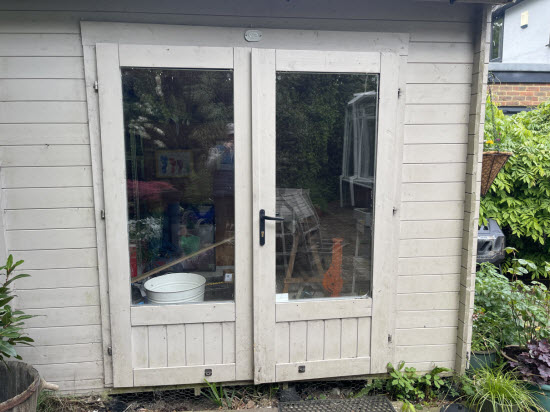 Typical log cabin doors requiring replacement
Why replacement log cabin doors can be hard to find
Some original manufacturers do sell replacement doors, but finding the right door and configuration can take persistence. The manufacturer may be difficult to identify, the model may no longer be made, or the replacement details may not be easy to find. Even when a door is available, its size, handing and hardware need to match the existing opening and frame.
Using a standard house door or shed door is not usually a straightforward substitute. Log cabin doors are commonly around 45 mm thick, but they have a rebated lip around the perimeter. This rebate, often about 30 mm, overlaps the frame rather than simply fitting inside the opening. It helps form the junction between door and frame, and the gap can accommodate rubber weather seals.
That shape is an important part of how the door fits and seals. A replacement needs to be made to suit the cabin, not just chosen because its overall dimensions look close.
And then once you have found the door you need someone to install it so it fits and moves well.
Small door problems can change how you use the cabin
Doors are one of the few moving parts on a log cabin, and they are the part you touch every time you go in or out. If a door sticks, fails to close properly or needs a shove to latch properly, the building feels frustrating to use. A poor seal lets in draughts and make the space uncomfortable, particularly if you want to use it as a workshop or office through the colder months.
Security matters too. Double doors often use a pair of bolts to hold the slave door in place, with a lock on the master door. On many cabins, the bolts supplied for the slave door are light-duty, while an espagnolette-style lock on the master door provides locking points at the top and bottom. The whole arrangement is only as dependable as its parts and how well the doors meet the frame.
A replacement can improve the original design
When I make replacement log cabin doors, I can build them to the opening and improve the parts that have caused trouble. I use engineered redwood, which is more stable than ordinary plain timber, and fit robust, adjustable hinges. Adjustment is useful because it allows the doors to be set up accurately on installation and makes later alignment easier if the building or doors move slightly over time.
For double doors, I can fit substantial bolts to secure the slave door and a five-lever lock to the master door. Rubber seals fitted into the groove help close the gap between the door and frame and reduce draughts.
The construction details used for the door matter as much as the hardware. A glazed door needs to resist racking: the tendency for it to move out of square as it is opened and closed. Some manufacturer-supplied doors rely on their mortice and tenon joints alone to provide that resistance. I include a fixed timber brace within the door construction to keep it square and dependable in use.
These details are easy to overlook when a door is new and working well. They become much more noticeable when the door starts to sag, the lock no longer lines up, or the cabin feels draughty.
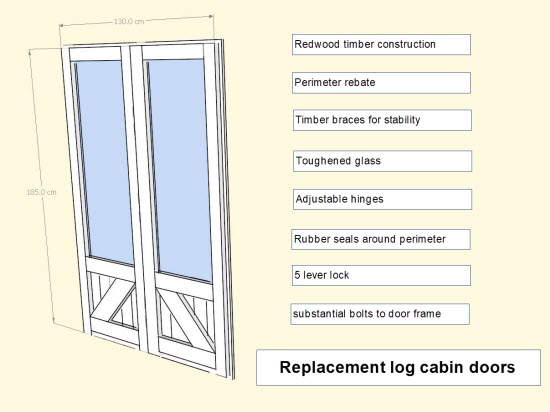 A short list of requirements for your replacement log cabin doors
Made-to-measure doors for an existing cabin
Replacing a log cabin door is not always a matter of ordering a standard size.
The door needs to:
- Fit the frame
- Incorporate seals
- Match previous construction
- Incorporate glazing
- Be braced for stability
- Have robust and adjustable hinges
When the original maker is unknown, measuring the opening and inspecting the existing door and hardware are useful first steps.
I can make and install replacement log cabin doors to suit an existing building. The aim is to restore easy everyday use while improving the hinges, locking and weather sealing where appropriate. That can make a real difference to a cabin that is otherwise in good condition and still has many years of useful life left.
If your log cabin doors are decaying, difficult to close or letting in draughts, send me a few photographs and the approximate opening dimensions. I can take a look and advise whether made-to-measure replacement doors are likely to be suitable for your cabin.




Keep in touch with our monthly newsletter
Shed Building Monthly