Why Do Log Cabin Corners Rot? and How Can They Be Repaired?
A freezer with food in it gave rats a reason to get inside the log cabin. A rotten corner caused by damp and decaying logs gave them a way.
Roof water had been running on to the corner joint, keeping the interlocking logs damp. As the timber decayed, the joint opened up. What looked like a local patch of rot had become both a pest problem and a potential structural one: those same corner joints help keep the cabin walls straight and upright.
So the repair had to do more than close the gap. It needed to restore the corner and allow for the movement of the logs through the seasons. Why do these joints hold on to water, and what does it take to repair one properly?
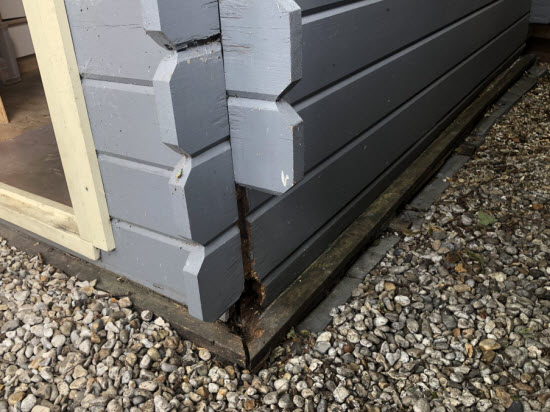 Log cabin corners showing decay. The bottom two logs have snapped completely.
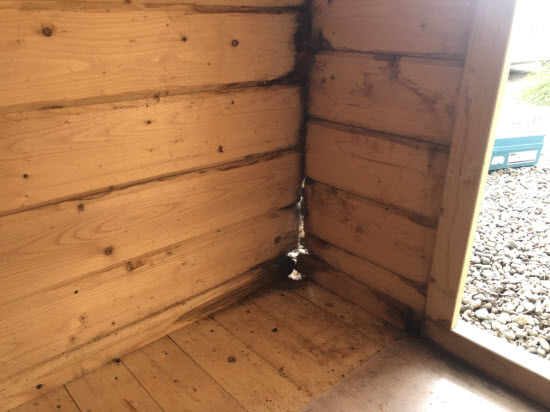 The same view from inside. The black staining is damaged timber. The holes allow small critters in.
Why are log cabin corners vulnerable to damp?
The logs in a typical interlocking cabin are not simply stacked in a straight pile. Each one has notches at its ends so it can cross and lock with the logs in the adjoining wall. The courses alternate: one wall's log sits half a log higher than the log crossing it at right angles.
That arrangement makes a strong, distinctive corner, but it also creates a complicated joint. There is exposed end grain within the notches, and the close surfaces can hold water by surface tension. If rain gets into the joint, it may not drain or dry as quickly as water on a flat, open surface.
Water may come from roof runoff, wind-driven rain or splashback from paving. A shaded corner with little sun or airflow will stay damp for much longer.
Exposure to the weather makes a huge difference. One cabin I repaired down by the coast had severe decay on the corners facing the sea and prevailing wind, while the more sheltered corners were in much better condition. The joint design may be the same all the way round, but the weather each corner receives is not.
A worn protective coating can also add to the problem. I am cautious about the use of paint on these joints: if water gets behind an impermeable film, it will have difficulty drying out. A stain protects the wood and helps it shed water without trapping it in the joint. The aim is to protect the timber while allowing the corner to dry if it becomes wet.
What are the early signs of a rotten corner?
Inside the cabin, look for water staining on the walls. It is often more obvious towards the floor, as water runs down through the joints and takes longer to dry at the bottom. Outside, the ends of the logs may have broken away or lost their crisp shape. The timber may feel soft when gently probed with a screwdriver.
Woodlice in the joint can be a clue that the timber has been persistently damp; they are associated with damp wood rather than being the cause of decay.
A quick look outside may not show how much timber has deteriorated within the joint. Dark staining, a new gap, soft wood or pieces breaking away are good reasons to investigate more closely.
Can a decayed corner affect the whole cabin?
The interlocking corners help keep the walls straight and upright. If one or two logs have begun to decay, the cabin may seem perfectly sound for a while. But if the rot continues to affect the ends of logs further up the wall, the interlocking connection becomes less reliable and the wall can begin to bulge or move out of shape.
You may eventually notice doors or windows becoming harder to open and close. Those symptoms can have other causes too, including movement in the base, but they are worth investigating when there is visible corner damage.
As joints open, they can also provide a route for rats or mice. In the freezer outbuilding, the corner had become a way into the building.
Is it possible to replace or repair rotten log cabin corners?
The short answer is yes. But you need to do it carefully and methodically.
Here's how I go about replacing decayed log cabin logs
First, I assess how far the decay has gone. I normally replace the damaged timber and continue a little beyond it, often by a log or two, depending on severity. Replacing whole log lengths is not always necessary and can make the job far more involved, as sound logs may have to be removed to release decayed ones.
The cabin needs to be supported before the damaged sections are cut out. I install high-capacity cabin jacks beside the repair, outside the main area that needs to be removed. They allow me to lift the cabin slightly, just enough to take the weight off the lower logs. Supporting it in the right place and understanding how the floor and walls work together are important parts of making a secure repair.
I cut out the damaged timber carefully with a circular saw, then use a multi-tool to cut through the final wood fibres without damaging the logs above.
Replacement logs with an interlocking profile are sourced from a local timber merchant to match the thickness of the existing ones. I make the interlocking corner sections in our workshop, as the notches take time and care to reproduce. I make the replacement pieces slightly overlength, then trim them accurately on site for a close fit.
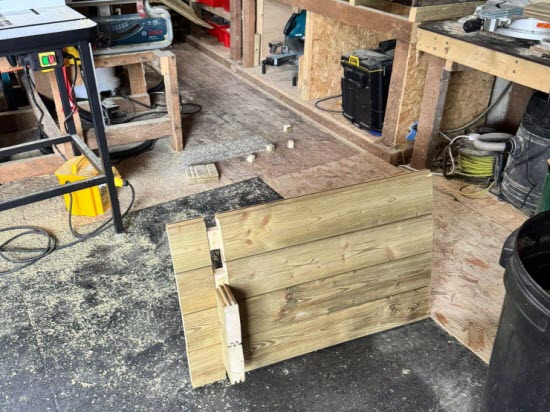 A corner repair under construction in the workshop
Sometimes the new tongue-and-groove profile does not match the old one exactly. In that situation, I can cut off the tongue and groove to create flat surfaces between the existing and replacement timber. The connection is secured with pocket screws. The coursing of the wall remains consistent; it is just that particular connection that uses a different detail.
Inside the building, a timber splice plate joins the old and new log ends. It helps prevent the logs from rotating while allowing the timber to expand and contract over time. We work on one corner at a time, which limits the risk of movement and makes it easier to correct the building as the repair progresses.
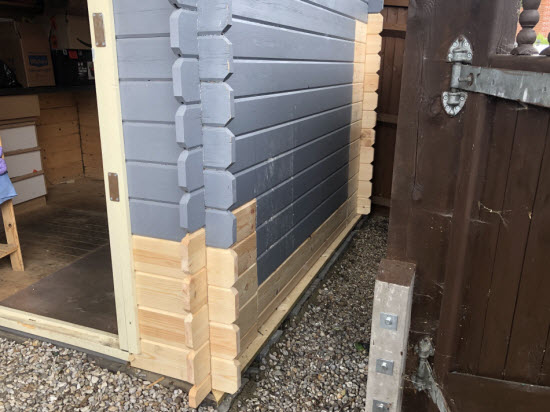 The completed corner repair from the outside
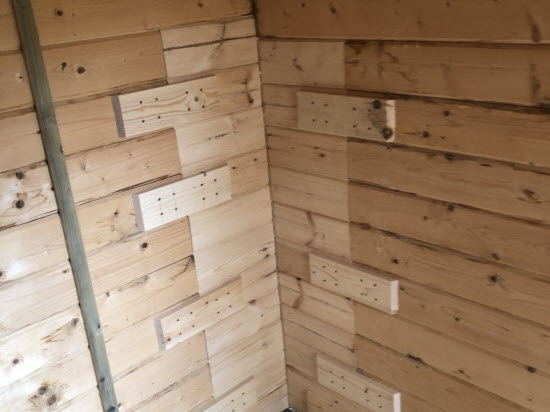 Corner repair from the inside, note splice plates. No critters getting in here.
Is this more than a DIY repair?
The work involves more than cutting away rotten wood and fitting a patch. The cabin must be supported properly, the replacement profile must suit the construction, and the repair must allow the logs to move with seasonal changes in moisture.
The right approach depends on the cabin and the extent of the damage. We have repaired cabins from about 2 x 3 metres up to around 5 x 5 metres. The location and exposure matter too: a large cabin in a sheltered garden may have sound corners, while a smaller one in an exposed position may have severe decay on its weather-facing side.
What is wrong with a quick repair?
Trying to seal a wet joint with filler or sealant can appear to solve the problem quickly and cheaply. But if water continues to get in, sealing it may make it harder for the trapped moisture to escape. The first priority should be to understand where the water is coming from and whether the timber itself needs replacing.
Sealant can sometimes be appropriate, but it needs to cope with movement. A flexible product such as Sikaflex can bond to fresh timber, but not to a wet, decayed surface. A brittle filler, such as a two-part epoxy filler, may crack or detach as the wood moves.
It is also important not to restrain the wall with fixed vertical ties. Log walls take in and release moisture during the year, and their height can vary—sometimes by as much as 25 mm. If the logs are prevented from moving, they can split or the wall can buckle. The repair needs to accommodate that natural movement rather than fight it.
How can you stop the corners getting wet again?
Start with roof water. It is not always obvious whether roof runoff is going to cause damage, but guttering is a sensible precaution, especially on a larger cabin with a substantial roof area. Make sure the water is carried away from the building rather than simply discharged directly beside it.
Check the ground around the base too. Water should not be allowed to pool against the cabin. The supports and drainage should give it a route away, and nearby paving or other hard surfaces should not send a concentrated splash back onto the walls.
Keep the timber coating in good condition and inspect the corners from time to time, particularly after winter or periods of heavy rain. Early signs are easier to deal with before decay has progressed through several courses of logs.
Could a small metal deflector protect the joints?
I am developing an idea for a pressed-metal deflector to shield the corner joints from the worst of the wind-driven rain. It would be a folded angle spaced away from the face of the logs, rather than a cover sealed tightly against them.
The gap-around 15 mm in the current concept—is intended to let air circulate and moisture evaporate if water does get behind the deflector. The design is still in development, so I cannot yet say how well it will perform in service. The principle is to reduce the rain reaching the joint without creating another place where damp can be trapped.
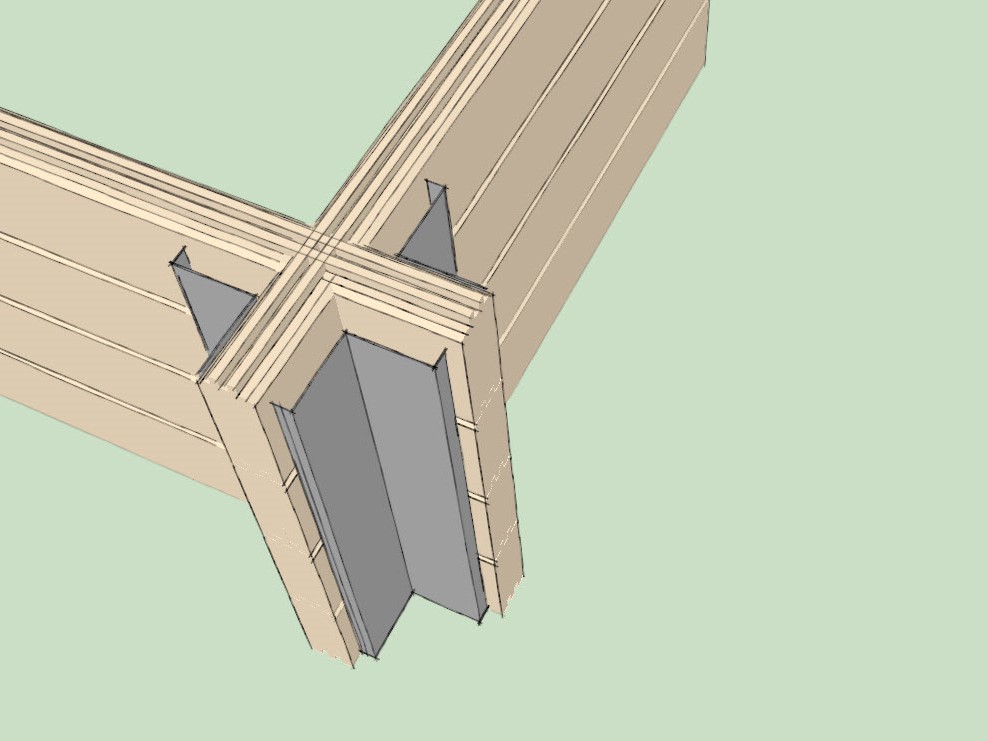 Moisture deflector to protect corner joint
Are any of your log cabin corners showing signs of decay?
If you have spotted soft timber, broken log ends, staining or gaps on a corner of your log cabin, it is worth finding out how far the problem has gone and what has allowed water in. A well-planned repair may let you keep using a sound cabin while addressing the cause of the damage.
If you are in West Kent or East Sussex, you can contact me through the enquiry page. Send a few photographs and a short description of the cabin and the problem, and I will let you know the most useful next step. You can also read more about the other work we carry out on our log cabin repairs page.




Keep in touch with our monthly newsletter
Shed Building Monthly