Decking Grip Mesh: how to make a practical anti-slip pathway to your shed or summerhouse
A timber deck that feels perfectly fine in summer can become alarmingly slippery once autumn arrives. The boards stay damp for longer, algae begins to grow, and a familiar walk to the shed or summerhouse can suddenly feel like crossing an ice rink.
It is particularly frustrating if you spent time jetwashing the decking earlier in the year. It may have looked spotless afterwards, but that does not stop a slippery film developing again when the weather turns damp. You do not need a thick carpet of moss for the surface to become treacherous.
So how do you make that everyday trip across the deck more sure-footed?
|
Decking Grip Mesh £14.82/Lin.m (UK Only)
|
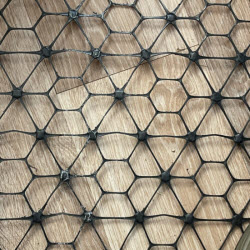


Create a walking route where you need it
Treating the whole deck sounds like the obvious answer. Adding sand to decking oil or paint might seem a simple way to roughen the surface, but it is difficult to get an even, lasting result from a homemade mixture. Purpose-made anti-slip coatings are available, although they still depend on preparation, wear and maintenance.
For many shed and summerhouse owners, a more practical approach is to create a defined walking route across the decking to the entrance. You concentrate the treatment where you actually walk, rather than coating every board.
There are several ways to do this. The differences become clearer when you look at the materials side by side.
Chicken wire: too flimsy
Chicken wire is cheap and readily available, which makes it tempting to fasten over slippery boards.
The problem is its flimsiness. The thin wire bends easily, and it is difficult to keep the whole surface neat and flat. In the photograph, you can see how the mesh has become distorted around the joins. There is also corrosion developing on the wire.
For a route you use regularly, I would rather have a more substantial grid than thin wire that is easily pushed out of shape.
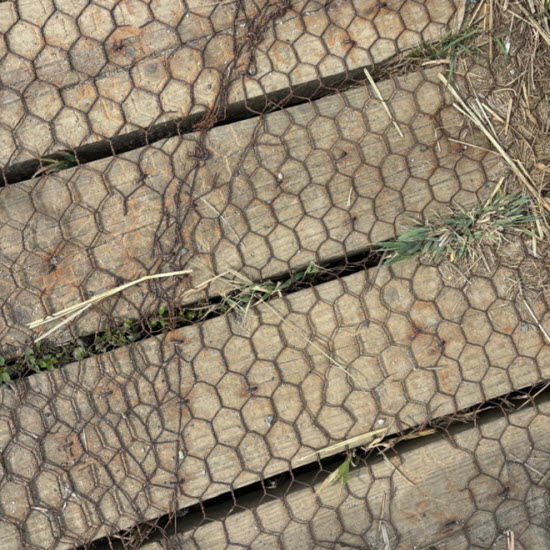 Chicken wire is inexpensive, but its thin wires easily bend out of shape, making it difficult to maintain a neat, flat pathway.
Weldmesh: a square grid with an industrial appearance
Weldmesh is more substantial. Its wires run at right angles and are welded together at each crossing, producing regular square openings.
However, the wires run in only two directions. It also has quite an industrial appearance: useful on a utility walkway, perhaps, but less appealing outside a garden summerhouse.
Cut edges and joins need careful attention too. The mesh must stay securely fixed against the boards, with no projecting wire ends.
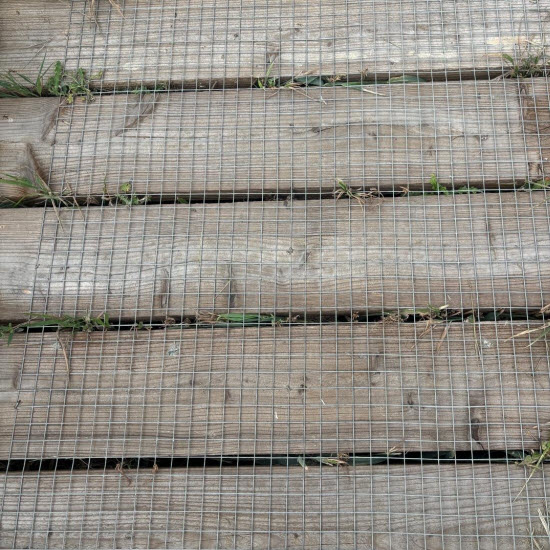 Weldmesh is more substantial than chicken wire, but its two-directional grid has an industrial appearance.
Fibreglass strips: intermittent coverage and a cost that adds up
Fibreglass anti-slip strips have a gritty surface and are made specifically for this kind of job.
Their drawback is the intermittent coverage. Each strip gives you a band of textured surface, with exposed timber between the strips. Where you put your foot still matters.
They can also become expensive when you need enough lengths to treat a complete route across the deck. Each strip needs positioning and fixing separately.
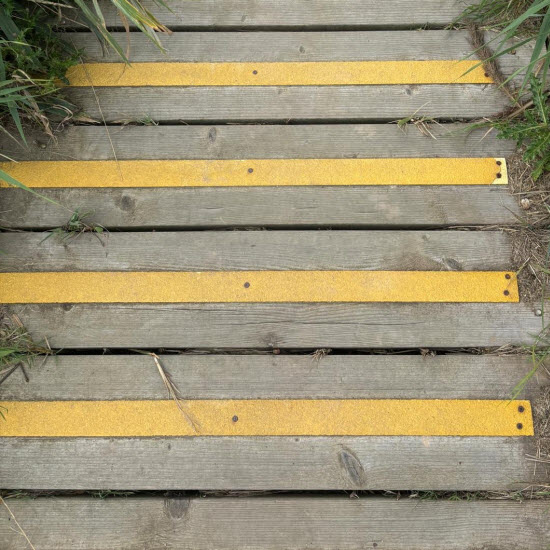 Fibreglass strips provide bands of gritted surface, leaving untreated timber between the strips.
Why I favour plastic Decking Grip Mesh
The Decking Grip Mesh shown below brings together the features I am looking for: a substantial grid, a pattern that runs in three directions, raised junctions and an appearance that suits a garden setting.
A stiff structure. This is not soft plastic netting. The plastic sheet is punched and stretched during manufacture, producing a stiff network of connected ribs. When properly laid out and fixed, it forms a flat pathway against the decking.
Ribs in three directions. The pattern includes triangular openings, together with larger openings. Its ribs present edges in three directions for shoe soles to engage with, rather than the two-direction arrangement of square weldmesh.
Raised junctions. The thicker nodes where the ribs meet add further points of contact underfoot. The appeal lies in the combination of ribs and raised nodes across the covered route.
Protection from sunlight. Carbon black incorporated into the plastic helps protect it from ultraviolet light. UV resistance matters for a material that will be exposed outdoors.
An attractive appearance. To my eye, the dark geometric pattern sits comfortably against timber. It gives the route a tidy, deliberate appearance without the industrial look of wire mesh. The plastic grid itself cannot rust.
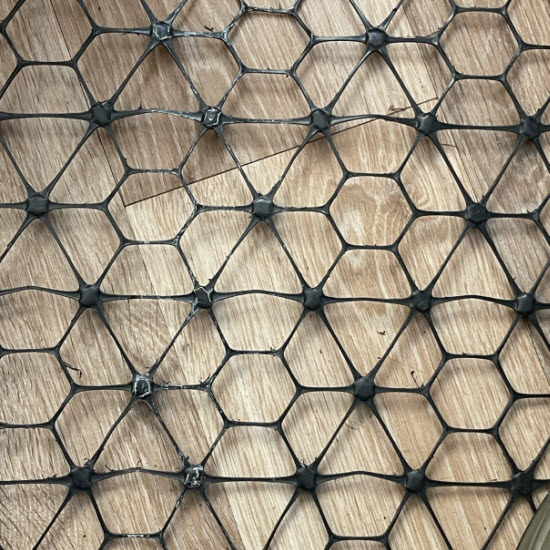 Decking Grip Mesh combines stiff plastic ribs and raised junctions in a dark geometric pattern that complements timber.
A practical improvement to your existing decking
For a walking route to a shed or summerhouse, this is the option I favour. It combines a stiff plastic structure with ribs in three directions and raised nodes, while keeping much of the timber visible through the openings.
It is a way to concentrate the improvement where it is most useful: on the route from your garden or house to the door.
Start with sound decking, clear away algae and debris, and secure the mesh so that the edges and joins lie flat. Continue to clear leaves and check the fixings as part of normal maintenance. Grip still depends on footwear and surface conditions, and care is needed in frost and ice.
Choose your decking mesh
Measure the length and of the walking route you want to cover.
The mesh comes in a continuous roll that is 550mm wide and available in the length you need. Just order the number of metres that you want.
If you are unsure, send me a photograph and the dimensions of your decking, and I will help you work out what to order.
|
Decking Grip Mesh £14.82/Lin.m (UK Only)
|




Keep in touch with our monthly newsletter
Shed Building Monthly