Shed Door Locks are the first line of defence to keep unwanted visitors out of your shed
The type of shed door lock that you use is driven by the type of door on your shed. A fully framed door can have a mortice lock in the same way that you have for your house. However most shed doors are of the ledged and braced variety and don't have a solid timber frame around the perimeter.
Locks for ledged and braced doors are normally fixed to the central ledger at the mid-height. You do see some sheds that have locks fixed to the upper and lower ledgers as well. But having three locks to undo must make opening the door a bit of a chore.
There is a balance to be struck between security and convenience of access to your shed.
So what types of shed door lock are suitable for a ledged and braced door?
There are four basic lock types you could use:
Rim Locks
Rim locks are the least secure of the options. The lock is fixed to the inside of the door with wood screws. The door catch secures into a strike plate or keep, fixed to the frame of the door.
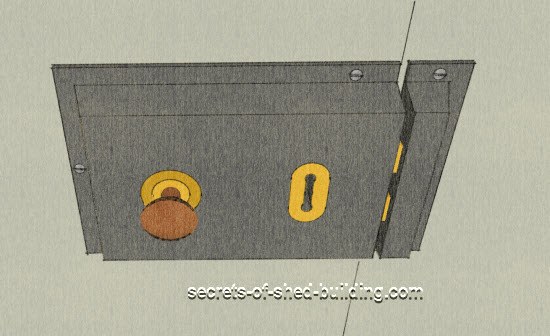 View of a rim lock set, from the inside
Many locks of this type have a latch bolt/spring bolt as well as a deadbolt. This means that the door can be opened and closed without locking with the deadbolt.
This type of shed door lock is convenient to use and quite unobtrusive as the body of the lock is on the inside of the shed door. However they are possibly the least secure of the shed door lock options. ep
A determined intruder can easily force the door open as the lock is only held in place by wood screws.
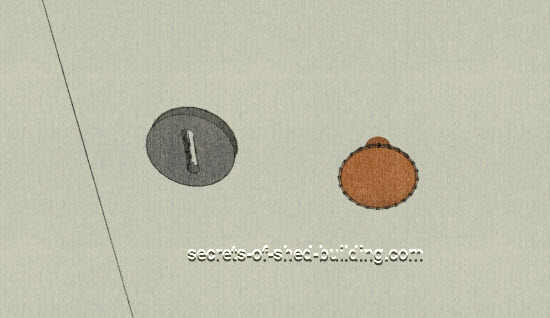 View of a rim lock set, from the outside.
Probably the neatest looking of all of the lock types, from the outside.
A recent improvement on the traditional Rim Lock is the 'Long throw bolt' type lock.
An excellent example of this is the 'Gatemate'. This product comprises a 1" stainless steel bar that is locked with a high security 6 pin lock.
Three reasons the Gatemate makes such a good shed lock are:
- The stainless steel bolt has a 'throw' of over 2" which makes it excellent for use with board and batten doors, where tolerances might not be as high as internal environments.
- The steel 'keep' that the bolt locates into has tolerance, again for doors and structures that move.
- The metal body of the lock is made of robust steel and comes supplied with security screws.
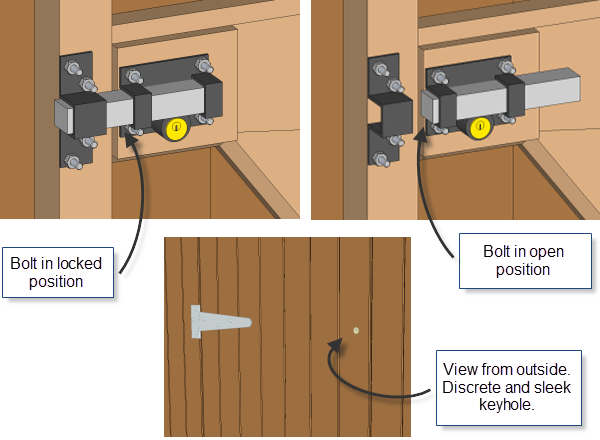 The Gatemate looks like it is made for the job and it is significantly stronger than other locking systems.
Pad bolt/Brenton bolt
Pad bolts, sometimes called Brenton bolts, are often used to secure garden gates. They consist of a flat or circular bar that slides horizontally within a mounting that is fixed to the outside of the door and door frame. To lock, the bolt is slid horizontally into a receiver that is fixed to the door frame.
The first image below is a standard pad bolt. Don't use one of these! They are not lockable.
If you choose to use a pad bolt make sure you get the lockable type which is the second image below.
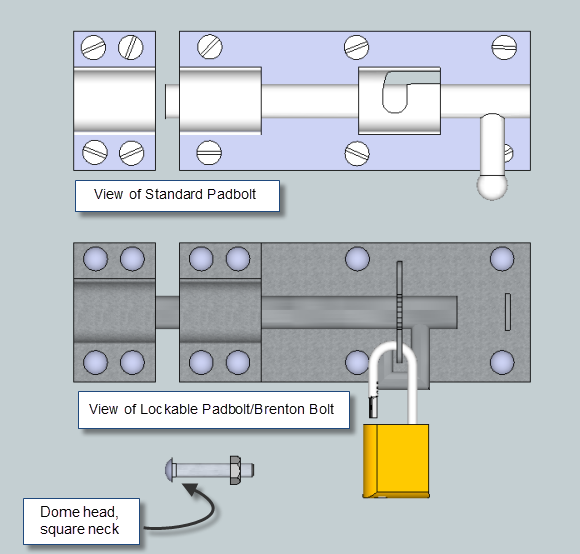 View of a standard padbolt
Use dome head square neck bolts to secure the housing and receiver to make the fixings as secure as possible. The dome head means that the only way of removing the hardware from the outside of the door is by cutting it off. The bolts pass right through the door frame or the door ledger. So they are held in place very securely.
Pad bolts are available in both zinc passivated, black painted and galvanised finishes. As the bolts will be outside and exposed to the elements I would recommend using a galvanised finish.
The bolt is locked in place with a padlock. Make sure that you buy an external grade padlock.
A padlock that is not built for external use will go rusty and seize up very quickly. Even with an external grade padlock you will need to oil it once a year to keep the parts moving.
Hasp and staple
The hasp and staple is a similar form of shed door lock to the pad bolt, in that it is fixed to the outside of the shed. The difference is that a hinged hasp is fixed to the door which when closed goes over a staple fixed to the door frame.
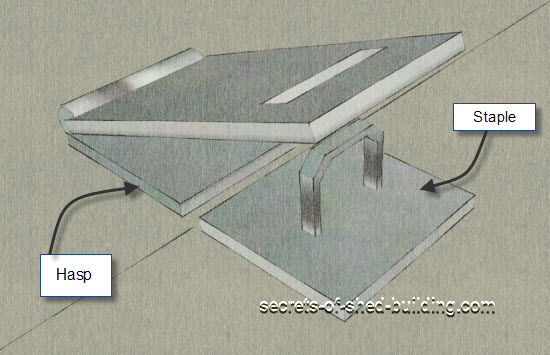 View of the two parts of a hasp and staple
Both pad bolts and hasp and staple fixings are available in a range of qualities. The cheapest are of mild steel which can be cut with a hacksaw.
Higher quality and more expensive branded hardware, such as those made by ABUS, often incorporate parts that are made from hardened steel. Hardened steel has been heat treated which means that an attempt to cut it with a hacksaw will be much more difficult.
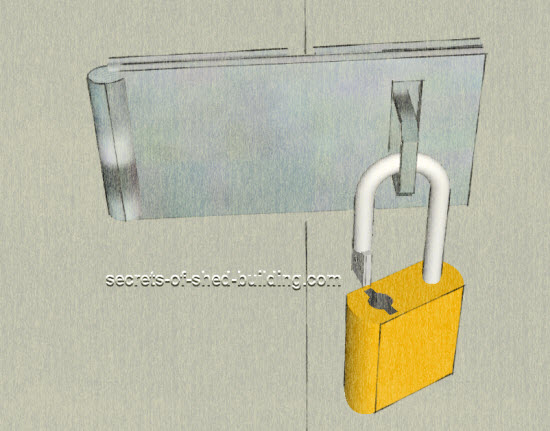 Closed hasp covers the fixings.
The security of a hasp and staple can be improved by choosing one that has a built-in padlock protector. The padlock protector is a metal shroud that is built into the hasp that covers the top section of the padlock. This extra layer of metal makes it more difficult for any would-be thief to cut their way in.
The final shed door lock in this section is door bars.
Shed door bars
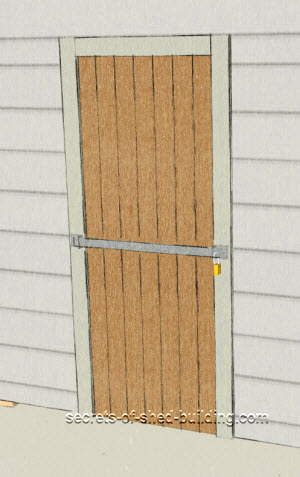 General view of a simple door bar
Shed door bars are an extra level of security on top of that provided by a lock. The most basic designs is a removable steel bar that is locked in place across the mid-height of the door. This bar helps to protect the door lock by preventing the door being moved outwards.
More advanced door bar designs are similar to a huge hasp and staple with one end of the bar being hinged rather than loose.
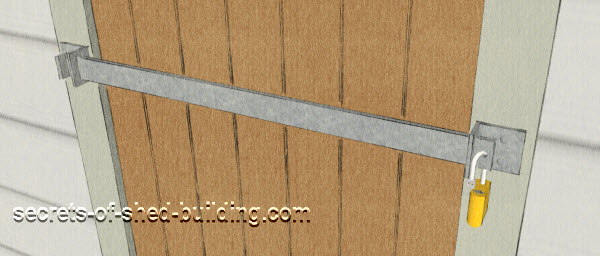 Closer view of simple door bar
For both varieties, the bar fixings should be fixed to the shed frame (rather than the cladding/siding) for maximum effect.
And finally....If an intruder does make it past your secure lock, is it gameover?
The answer is no, there is a bit of hardware called a Shed Equipment Anchor that enables you to securely lock equipment to the frame of your shed. It is yet another hurdle for a potential intruder to overcome.
Find out more about the Shed Equipment Anchor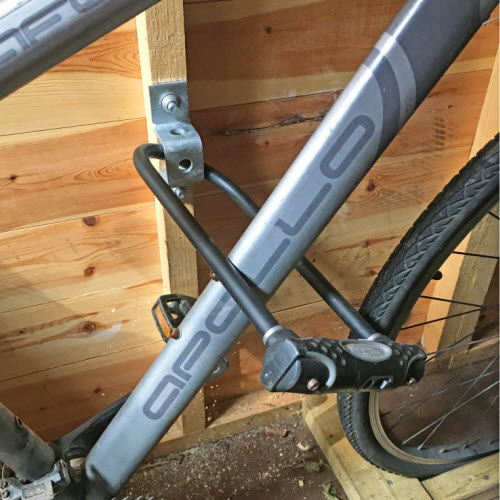 The Shed Equipment Anchor used with a D lock to secure a bike to the shed wall
Related posts:
- What are the options for installing an alarm in your shed?
- How to build a strong shed door
- A review of the different types of shed door

Looking for more information on how to get your shed door working perfectly?
Return from Shed Door Lock to the Shed Door Hardware hub page



Keep in touch with our monthly newsletter
Shed Building Monthly